
Miami Realtor Saved By UHealth Doctors After Suffering a Stroke
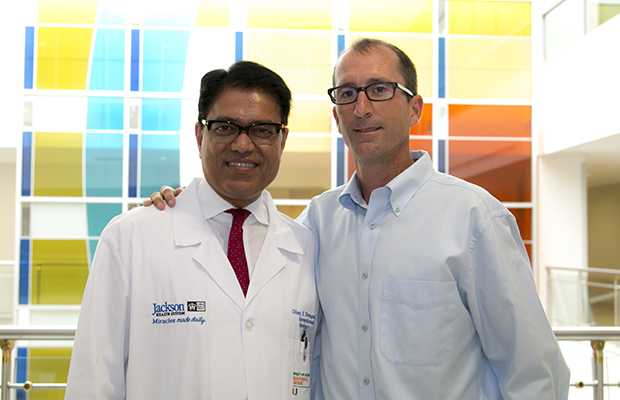
Carlos Fox always considered himself healthy – he runs, goes on regular bike rides, and isn’t overweight.
However, in October 2015, while at the Miami Springs office where he works as a realtor, Fox, then 44, suddenly lost control of the left side of his body and fell to the ground. A co-worker found him on the floor conscious but with slurred speech and the inability to move his left side. He immediately called 911.
When Miami-Dade Fire Rescue arrived, one of the paramedics recognized that Fox was suffering from a stroke.
Stroke is the fifth leading cause of death and a leading cause of adult disability in the United States, according to the American Heart Association/American Stroke Association. On average, someone in the U.S. suffers a stroke every 40 seconds; someone dies of a stroke every four minutes; and 795,000 people suffer a new or recurrent stroke each year.
“This was eye opening,” Fox said. “I have always taken care of myself – so for this to happen to me, it was shocking.”
Fox was rushed to Jackson Memorial Hospital, part of an elite group of healthcare organizations focused on highly specialized stroke care. Jackson Memorial is one of just five nationally recognized, state-certified Comprehensive Stroke Centers in Florida, offering a wide range of specialties around the clock for the most complex strokes.
Within minutes of Fox arriving to the emergency department, doctors administered IV tPA, a medication that dissolves blood clots.
Soon after, Dileep R. Yavagal, MD, MBBS, FSVIN, FAAN, FAHA, UHealth – University of Miami Health System director of interventional neurology and co-director of endovascular neurosurgery at Jackson Memorial Hospital, performed a thrombectomy, a procedure to open the blocked artery in the brain by minimally invasive removal of the clot causing the blockage. This is done by threading a thin long tube from the artery in the groin into the blocked artery in the brain under specialized X-ray guidance. A device called a stent retriever is then passed through the tube into the clot to catch the clot and remove it.
Since 2015, the new standard of care treatment for paralyzing strokes is to emergently perform catheter surgery, mechanical thrombectomy, to rapidly open the blocked artery in the brain along with or without the clot-busting medication, tPA. This is most effective within the first six to eight hours of stroke symptoms. UHealth physicians at Jackson Memorial Hospital are pioneers in South Florida, and the nation, in bringing mechanical thrombectomy from its very early stages of use in the mid-2000s, to being the widely recognized standard of care today.
The procedure proved successful for Fox, who immediately regained movement on the left side of his body. The ability to walk and talk normally followed soon after.
Because of the early intervention, Fox suffered no permanent, devastating effects from the stroke.
“The attention I got at Jackson was unbelievable,” he said. “I was blessed to be taken there.”
Within a week of leaving the hospital, Fox returned to work. He resumed all of his normal activities, including exercising, and enjoys spending time with his wife of 20 years and three children.
What Fox learned from his health scare is that everyone should know the warning signs of stroke – face drooping, arm weakness, and difficulty speaking – and call 911 immediately if any of them are spotted.
“Strokes to me were something that happen to older people, not people my age,” Fox said. “But obviously that is not the case. Anyone can suffer from a stroke.”