
UHealth Neurosurgeon Cures Rare Type of Stroke in 28YO Air Force Trainee


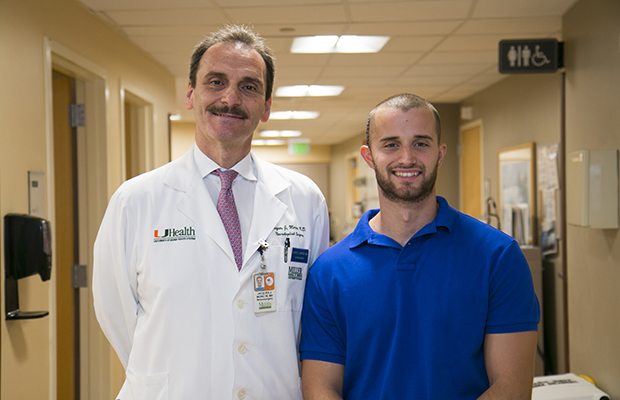

The puzzling and odd symptoms hit 28-year-old Paul Casas during arduous special-ops military training in San Antonio, Texas last year. His left arm would often go numb, his memory began deteriorating, he suffered frequent headaches, and studying became more challenging. However, the married father of two daughters dismissed the symptoms, attributing them to the intensity of the exercises. But when his headaches began to take place daily, he checked into the military hospital on base.
It was last April when MRI and CT scans of his brain led doctors to diagnose Casas with Moyamoya disease on the right side of his brain. It’s a type of stroke disorder that causes the carotid artery and the arteries inside the brain to slowly close off, giving patients repeated strokes and sometimes bleeding in the brain. The disease is so rare it affects less than one in a million people.
“I was discouraged with the news because I was so close to finishing my training,” Casas said. “But ultimately my health came first because I had to be there for my daughters, wife, and family.”
Casas desperately sought a solution, but said that, instead, he found a lack of knowledge and resources to cure Moyamoya. His wife, Stephanie, left her Miami Lakes home to help her husband consult with universities and hospitals across the nation. Many advised them to just “wait it out,” but they didn’t want to take the risk that Paul’s condition would worsen to include a stroke or hemorrhage.
Ultimately, they contacted a friend who was familiar with the work performed by the physicians in the Stroke Division at the Miller School of Medicine Department of Neurology. Stephanie sent Paul’s information to one of the UHealth stroke neurologists, Amer Malik, MD, MBA, who was able to review the situation and the neuroimaging performed to date. He suspected Moyamoya was the likely diagnosis, but additional investigations needed to be completed on an emergent basis to confirm the condition.
Dr. Malik advised that if the Moyamoya diagnosis was indeed confirmed, his colleague, Jacques J. Morcos, MD, one of the most experienced neurosurgeons in the country, was available to perform the necessary surgery.
“As soon as the military gave Paul permission to leave, we drove from San Antonio to Miami,” Stephanie said. “We were so happy that Dr. Morcos was willing to take on Paul’s case.”
Dr. Morcos, director of cerebrovascular surgery and skull base tumor surgery at UHealth – the University of Miami Health System, expertise includes treatment of cerebrovascular diseases (stroke, carotid stenosis, aneurysms, vascular malformations, cavernous angiomas) as well as complex tumors of the brain, and the base of the skull (meningiomas, pituitary adenomas, acoustic neuromas, malignant tumors and others) at UHealth and Jackson Memorial Hospital.
“A large part of the right side of the brain was ‘hungry’ for more blood flow. We call it ‘misery perfusion’,” Dr. Morcos said. “The best approach in Paul’s case was to perform a surgery that would essentially give him a new artery to supply blood flow to the right side of his brain.”
The surgery is called a double-barrel STA-MCA bypass for the prevention of stroke. Superficial temporal artery to middle cerebral artery (STA-MCA) bypass is used to treat complex aneurysms, stroke, Moyamoya, and other complicated brain tumors. It is delicate surgery, with the thread of the suture used being five times thinner than a human hair.
The four-hour-long surgery took place on Wednesday, May 24, just days before Memorial Day.
“When I finally saw Paul, he was bandaged and I was scared at first,” Stephanie said. “But when he saw me, the first thing he asked me was if I already had lunch, and I knew then everything was going to be alright.”
Casas’ symptoms immediately disappeared and he was able to go home the following Saturday, just four days after surgery.
“His thinking and memory immediately became much clearer,” Dr. Morcos said. “He even surprised his wife by remembering things he would normally forget, like his daughters’ birthdays.”
The family is thankful to the neurosurgery team at UHealth, the ER and ICU teams at Jackson Memorial Hospital, for their nurturing support and multidisciplinary care during this challenging time.
“With Dr. Morcos fixing me, I’m definitely excited to get back into school and start studying again and see the difference that this extra blood flow to my brain is going to be able to help out,” Casas said.” “I never felt like I was missing out on life’s little things until this diagnosis.”