
After seven years, young woman makes full recovery despite two aneurysm ruptures, saved by Ryder Trauma and Jackson Memorial neurosurgery teams
By: Krysten Brenlla
Jennifer Collins, 30, always had a passion for helping people. Her dream was to become a doctor, so she could learn about the human body and help patients overcome health setbacks.
Collins never would have thought that she would be the one in the hospital bed, fighting for her life and receiving care from the very people she aspired to be.
“I was 23 and in medical school in the Caribbean. On September 29, 2016, I went to dinner with my friends, and apparently when we came back to the apartment, I told my friends that I had a huge headache, and I collapsed,” she said. “That’s all I remember before waking up in the hospital in Miami.”
Within 48 hours, Collins was transferred to Ryder Trauma Center at Jackson Memorial. She was comatose, presenting with a pulmonary embolism, an extensive hemorrhage, a ruptured aneurysm, strokes, and hydrocephalus, which is a neurological disorder caused by an abnormal buildup of fluid in the brain.
“Jennifer’s aneurysm was large and long, and presented in an uncommon location,” said Robert M. Starke, MD, co-director of endovascular neurosurgery at Jackson Memorial Hospital, and a UHealth – University of Miami Health System neurosurgeon and neuroradiologist. “She also had dissections in her vertebral arteries, potentially from the trauma of her fall after the aneurysm ruptured. This is not something you usually see unless the patient was in a motor vehicle accident or had a connective tissue disorder.”
Dr. Starke and his team rushed Collins to the operating room.
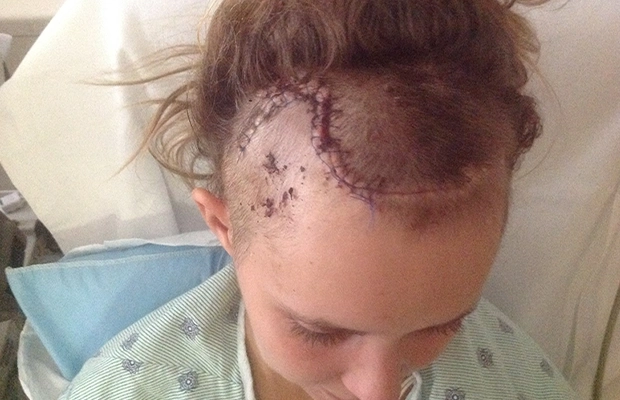
“The first thing we did was make an incision and a hole in the bone, and we placed an external ventricular drain, which can help drain the fluid from the brain to keep it under lower pressure,” Dr. Starke said. “She did not improve with drainage of cerebrospinal fluid, and in many centers, she would have not been treated further – but at Jackson, we feel very strongly that patients with ruptured aneurysms should be treated aggressively.”
After extensive discussions with her family, Collins was taken into surgery to clip her aneurysm. She was then transferred to the neurointensive care unit (ICU) at Jackson Memorial for observation.
“In a delayed fashion, patients with ruptured aneurysms can develop cerebral artery spasm, which causes narrowing of the blood vessels in the brain, and strokes,” Dr. Starke said. “To treat the spasm, Jennifer required three separate treatments, where we used balloons and medications to reopen the blood vessels.”
While in the ICU, Collins also developed acute respiratory distress syndrome (ARDS), which occurs when patients vomit at the time of aneurysm rupture. ARDS results in mortality in more than 40 percent of patients, and it created an inflammatory reaction in her lungs that affected her swallowing.
Collins required aggressive treatments to remove secretions from her lungs. The neuro-critical care team managed her respiratory failure by supporting her breathing on a ventilator.
Collins still had a long road toward recovery. Despite her improvements, she also developed cardiac stunning, which is a reaction to all the stress on the body. If left untreated, it can lead to heart failure and death.
“I remember that night like it was yesterday,” said Kristine O’Phelan, MD, co-director of the neurosciences critical care unit at Jackson Memorial and a neurointensivist at UHealth. “I came in and sat with her all night because her breathing was compromised. We changed her medication, put her on oxygen, and over time, she slowly improved. She’s so strong and resilient; her family was super supportive – she had a lot of things going for her.”
After the team treated her spasm, heart failure, and ARDS, Collins was still having trouble absorbing the brain fluid on her own.
“When a patient has that amount of bleeding and fluid in the brain, they don’t absorb the fluid on their own, and it will build up and squash the brain,” Dr. Starke said. “After we treated her spasm, we went back in, added a shunt in the brain’s fluid space, and connected it to a valve. When the pressure in the brain is above normal, the valve drains it.”
It was not until her second week in the hospital that Collins started to show some signs of brainstem reflexes. By October 6, about 10 days after her treatments, she was starting to wake up and follow commands, which let the team know she was still there.
“I was in the ICU for about a month, and all I remember was thinking how much I really wanted a white Christmas back home in Canada,” Collins said. “I fought as hard as I could to make that happen.”
Despite the challenges, she recovered quickly, and on October 29, Collins was transferred to a regular patient floor at Jackson Memorial.
Upon discharge from the hospital, Collins required intense rehabilitation therapy to relearn how to eat, walk, talk, and perform day-to-day activities. She also needed therapy to work on her short-term memory, which was affected by the aneurysm rupture and strokes.
“The journey was really long; I was like a toddler,” she said. “My therapists put up with so much. But, with the help of the team at Jackson and my family, I was determined to get through it.”
After a month of rehabilitation therapy at the former Jackson Rehabilitation Hospital, Collins’ dream of a white Christmas came true – she returned to Canada in December, and continued her rehabilitation journey toward a full recovery back home.
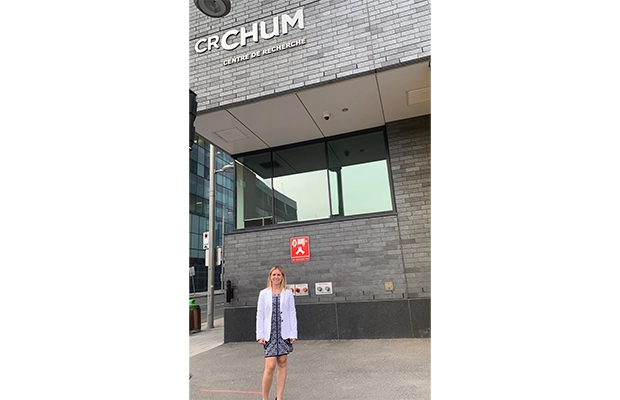
Although her aneurysm was initially secured, in 2017, Collins had another aneurysm grow and rupture. However, despite the two aneurysm ruptures, Collins has made a full recovery thanks to the work of her neurosurgeons at Jackson and Notre Dame Hospital.
Today, she is working on her master’s degree in biomedical science, with a goal of becoming a research coordinator. Collins recently published a research article on managing intracranial aneurysms, which she hopes helps raise awareness about aneurysm ruptures.
She’s grateful for the medical teams at Jackson and at Notre Dame that helped save her life – despite the overwhelming odds against her.
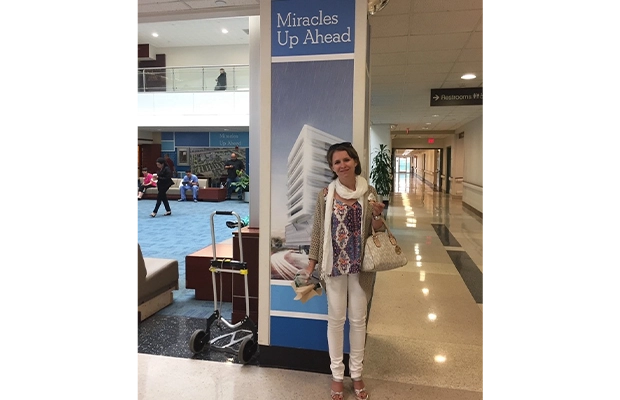
“There’s not enough words to say how grateful I am for Jackson,” Collins said. “If I am where I am now, it’s because of them – how they motivated me, how they treated me,” she said. “Because of Jackson, I can tell myself – ‘t’es belle, t’es bonne, t’es capable,’ which means, ‘you’re beautiful, you’ve got this, don’t give up.’”