
Early Diagnosis Gave Baby Boy a Path to Treat Craniosynostosis

By Carla Palmer
When Ashley Thomas took her 1-month-old son, Mason, to a routine pediatrician appointment, craniosynostosis was not a word she had ever heard before.
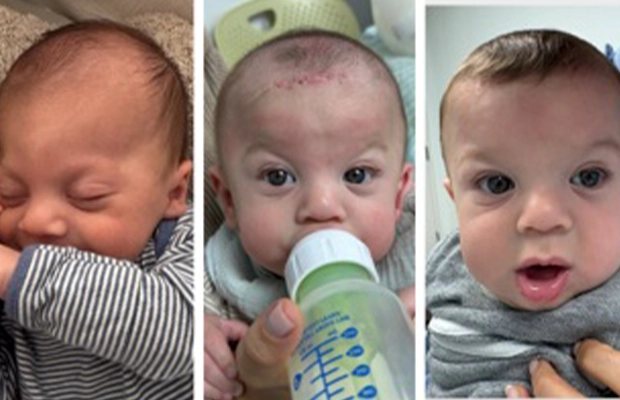
Mason seemed like a healthy baby. But during the appointment, his doctor noticed something unusual about the shape of his head. She measured it and recommended that Ashley and her husband, Dovid Thomas, have it evaluated further.
“I thought, ‘No, this can’t be. He isn’t going to have anything like that,’” Ashley recalled.
What followed were weeks of appointments, uncertainty, and waiting for a diagnosis.
By the time Mason was around 6 weeks old, his family was connected with Heather McCrea, MD, PhD, the director of pediatric neurosurgery at Holtz Children’s Hospital and a UHealth – University of Miami Health System pediatric neurosurgeon. Before meeting Dr. McCrea, Mason had undergone a CT scan that confirmed what Dr. McCrea could also recognize from his head shape: he had metopic craniosynostosis.
Normally, a baby’s skull is made up of bones separated by flexible joints called sutures. Those sutures remain open during the early years of life, allowing the skull to expand as the brain grows. With craniosynostosis, one or more sutures close too early, restricting skull growth and creating an abnormal head shape.
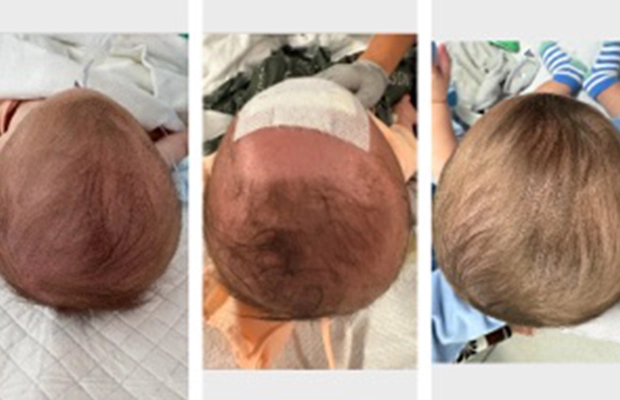
In Mason’s case, the metopic suture, which runs from the top of the nose toward the soft spot on the top of the head, had closed too soon. That prevented his forehead from widening normally and created a triangular head shape.
Craniosynostosis is typically treated surgically. In addition to correcting the abnormal head shape, surgery addresses the possibility that a child could develop increased pressure in the brain as the skull restricts its growth.
“When we catch this early, as in Mason’s case, we have two different surgical options,” Dr. McCrea said.
For babies diagnosed early enough, doctors can perform an endoscopic, minimally invasive procedure through a small incision just behind the hairline.
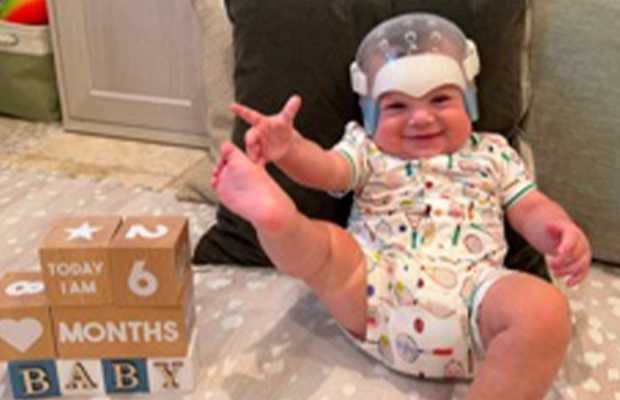
During the procedure, they remove the portion of bone that fused early, releasing the skull so it can grow more normally. After surgery, the baby wears a specially fitted helmet that helps guide the skull into a rounder shape as the brain grows.
The procedure is typically performed at around 3 months old. Children diagnosed later may not qualify for the minimally invasive approach and instead require a more extensive open operation to reshape the skull.
“It’s really wonderful when pediatricians or families identify that the child has a very abnormal head shape early on. They can send the child for early evaluation, and we don’t require any imaging first since diagnosis can often be made without imaging,” Dr. McCrea said.
Even knowing that Mason was a good candidate for the less-invasive surgery didn’t erase Ashley’s fear.
But from her first appointment with Dr. McCrea, she felt reassured.
“There was something about Dr. McCrea,” Ashley said. “I don’t know if it’s because she’s a mom or because of her bedside manner, but even though I was extremely nervous and anxious, she calmed my nerves.”
On the morning of Mason’s surgery, Ashley and Dovid were surrounded by family. While they were confident, fear still crept into Ashley’s mind.
“The hardest moment was handing Mason to the nurse as he went into the operating room,” she said. “You can’t prepare for that moment as a parent.”
He was in the operating room for a little more than an hour, and Dr. McCrea successfully released the fused suture.
Mason spent just one night in the hospital for observation and was discharged the following morning. Dr. McCrea said he looked great, and Ashley remembers being amazed by how quickly he bounced back.
“By the next day, he was honestly back to himself,” Ashley said. “It’s crazy how resilient children are.”
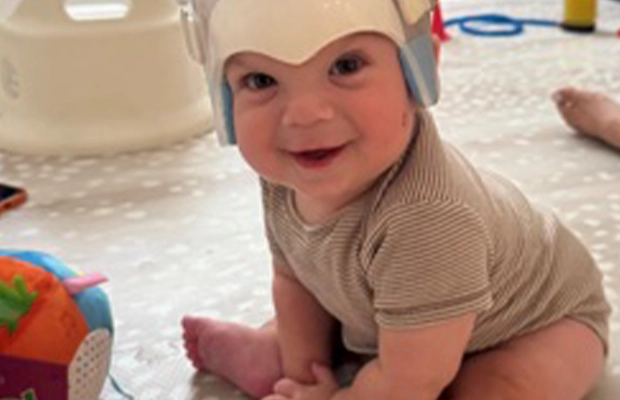
Mason’s treatment didn’t end when he left the hospital. He soon began helmet therapy to continue reshaping his skull as he grew.
“We’ve seen such a change in the shape of his head,” Ashley said. “It’s drastic how different he looks and how normal everything seems.”
Now at a little more than 5 months old, Ashley described Mason as rolling over, making sounds, interacting with his older brother, Aidan, and putting just about everything he can find into his mouth.
“He’s the biggest, happiest boy in the world,” she said. “He’s just the sweetest thing and so happy to be here.”
Dr. McCrea expects Mason to live a normal life.
“Hopefully, this will just be a blip on our radar,” Ashley said.
Today, she hopes Mason’s experience can offer another parent some of the reassurance she needed then.
“Talking about it and raising awareness helps,” Ashley said. “It helps to know he will continue to live a normal life and that this is just part of his history. I would have wanted someone to tell me it was going to be okay.”

Heather McCrea, MD
Neurological Surgery, Pediatrics
Holtz Children’s Hospital
1611 NW 12th Avenue Central Tower, Suite 150, Miami, Florida 33136