
How One Patient Overcame Years of Debilitating Knee Pain with a Personalized Knee Replacement Technique

By Carla Palmer
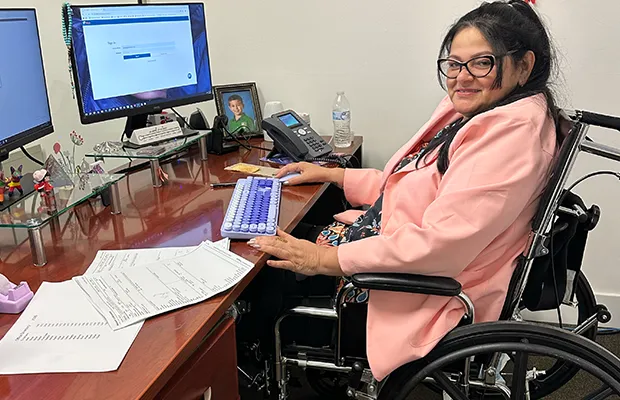
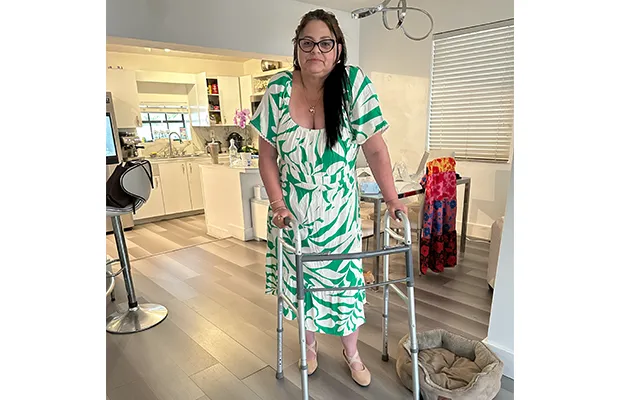
For most of her life, 58-year-old Mariela Lopez lived with severe knee pain. The mother of two who moved to Miami from Cuba 19 years ago spent decades trying to push through arthritis, constant dislocations, and cartilage loss that slowly stole her independence.
“Since I was 16, I’ve had arthritis problems in my knees,” she said. “As I got older, my quality of life kept getting worse and worse until I could barely walk anymore.”
By January 2025, the pain became unbearable. She could no longer go upstairs without holding onto walls. Even simple everyday moments, like walking around the house, getting out of the car, or standing long enough to cook, had turned into a challenge.
Her breaking point came while doing one of the things she loves most: traveling.
“On our last trip to Paris and Madrid, I would walk in the morning, and then I had to spend the whole afternoon lying in the hotel bed with lidocaine on my legs because I couldn’t stand anymore.” Lopez said.
When she returned to Miami, she knew she couldn’t continue living this way. She heard of success with knee replacement surgeries, so she scheduled a consultation with Jeffrey Alan Rich, DO, an orthopedic surgeon at Jackson South Medical Center.
“He was amazing from the moment I arrived,” Lopez said. “Everyone there was so professional. We decided I would have surgery on both knees.”
Dr. Rich uses a specialized knee replacement technique known as measured kinematic alignment. This method is designed to rebuild a patient’s knee the way their body was originally configured.
“The standard way to do knee replacement is called mechanical alignment,” Dr. Rich said. “That means you put everybody’s knee perfectly straight at zero degrees. But anatomy studies show that most people aren’t born with perfectly straight knees.”
In fact, only about 10 to 15 percent of the population naturally has “zero-degree” alignment. The other 85 to 90 percent have a natural bend — either slightly bow-legged or slightly knock-kneed.
Traditional knee replacements force all patients into the same straight alignment. That can overtighten ligaments, especially the inner ligament, leading to pain, stiffness, or instability.
“People used to complain of pain on the inside of the knee,” Dr. Rich said. “Since I started doing kinematic alignment, all those complaints have gone away.”
Instead of forcing every knee into the same position, measured kinematic alignment restores the knee to the way the patient was born, preserving natural ligament tension and avoiding unnecessary cuts or releases.
“You’re putting the knee back in the position they were born with,” Dr. Rich said. “You’re not overstretching any ligaments, and patients do much better.”
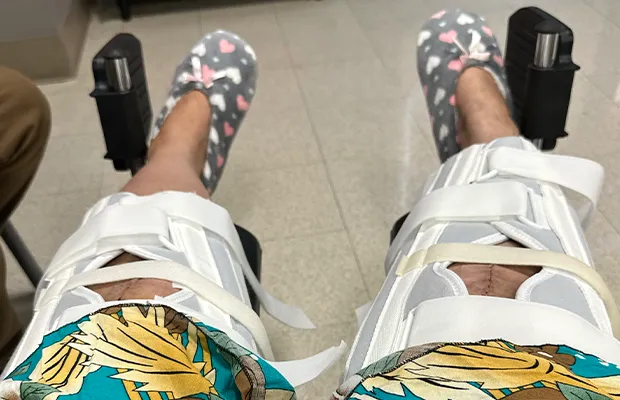
Lopez underwent bilateral knee replacement on March 17. But because her knees had been in such bad shape for so many years, she needed an additional early intervention to support her recovery, unrelated to the alignment technique.
But despite the difficulty, she stayed optimistic.
“Everyone told me getting both knees done was crazy, that I wouldn’t be able to walk,” she said. “But I put all my trust in Dr. Rich, and here I am.”
Today, she can do things she hadn’t been able to do in decades. She goes to the gym three times a week, she walks without pain, she climbs stairs with no pain— something that once felt impossible. And she enjoys her daily life again.
“There are still some days where I get a little swollen, but I’ve never again felt the pain I had before my surgeries. Never again have I felt like I have to scream from pain.” Lopez said.
The transformation has been so significant that she has already encouraged her brother to see Dr. Rich for his own knee issues.
While recovery still takes about two or three months and every patient heals differently, Dr. Rich sees a consistent pattern with kinematic alignment: a life with little to no knee pain.
For Lopez, the results speak for themselves.
“Jackson South is the best I’ve seen as far as hospitals and attention go,” she said. “They gave me my life back.”