


By: Ruelle Champion
For more than a decade, kidney disease slowly but surely changed Jamie Ousley’s life.
It started with abnormal blood work results. “About 10 to 12 years ago I was diagnosed with IgA nephropathy,” he shared. “I was fortunate that I didn’t have many symptoms of kidney disease until it got to stage four.”
IgA nephropathy is an autoimmune kidney disease that causes antibodies to build up in the kidneys and eventually leads to inflammation, damage, and kidney failure. As the years passed, Ousley’s kidney function decreased, impacting his life as a jazz musician and professor at Florida International University (FIU).
“I started feeling tired all the time,” said Ousley. “But I think I’m very lucky that I had no other symptoms.”
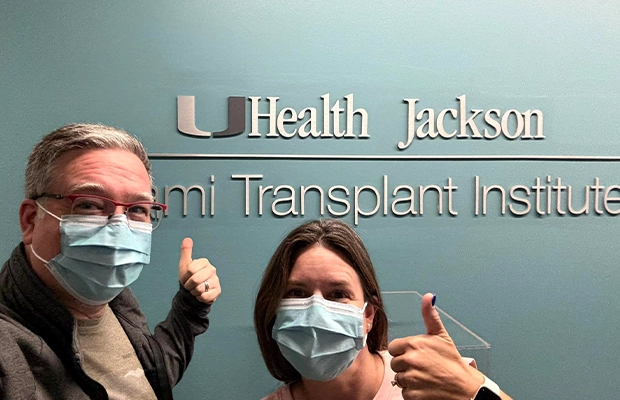
The next step for him was a kidney transplant. His nephrologist connected him with Miami Transplant Institute (MTI) — a partnership between Jackson Health System and UHealth University of Miami Health System in 2022. The uncertain wait time for a deceased donor posed a risk to Ousley’s health but the living kidney donor program at MTI became a beacon of hope.
“It’s important because patients are waiting years on the list for a transplant,” said Giselle Guerra, MD, medical director of the MTI living kidney donor program. “The list continues to grow because end-stage renal disease is becoming more common, not only in the United States, but throughout the world.”
The living kidney donor program shortens the organ waiting period through family, friend, or altruistic donors giving one of their kidneys to someone in need. The recipient gets a better matched kidney that improves post-transplant outcomes, and the donor goes on to live a normal life.
“The living kidney donor option is the heart and soul of the kidney transplant program,” Guerra said.
Guerra’s team guided Ousley through having the conversation and it was his family who led the charge to find a match.
“I remember asking, ‘how do I ask somebody for a kidney’,” he said. “It’s not something you can ask for, but you can talk to people about it.”
Ousley’s two sisters sprang into action and set out a call to action on Facebook, urging family members to get tested.
Sarah Overman, his cousin from Arkansas, answered the call that could give him a second chance at life.
“With his energy level being so low, it impacted his ability to do what he loved,” said Overman. “It was really hard to see that he had to stop being able to perform. It made me feel so sad that he couldn’t live his full life.”
Overman was a match. The pair were offered the robotic surgical option on July 10, 2025 —meaning faster recovery, smaller incisions, and less time in the operating room. Sarah was discharged a day after the surgery. MTI is one of few transplant centers in the world that offers robotic procedures for both recipients and donors.
“I think I was positioned to be able to do it. Everything that we do has a ripple effect,” said Overman. “He’ll be able to impact people who hear his music and the impact of that decision continues to ripple outward.”
Ousley was discharged on July 14. The impact has already started for him post-transplant now that he’s back home with his wife.
“It’s taken a little while for my body to recover, but I already feel my energy coming back to where it was a few years ago,” he said. “I was on the verge of going on dialysis, and I was very fortunate to not have experienced that.”
He’s planning to return to teaching at FIU for the spring semester, playing his bass at gigs throughout Miami, and spending time with loved ones for every holiday to come.
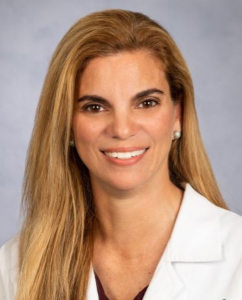
Giselle Guerra, MD
Internal Medicine, Nephrology
Miami Transplant Institute
1801 N.W. 9th Avenue Miami, Florida 33136