
Non-surgical procedure for enlarged prostate helps Jackson employee “Feel Normal Again”

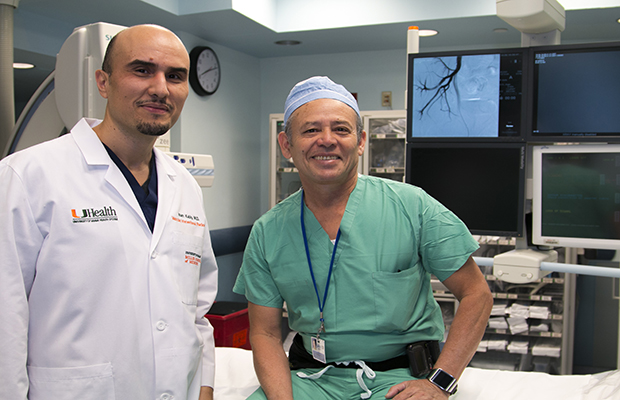

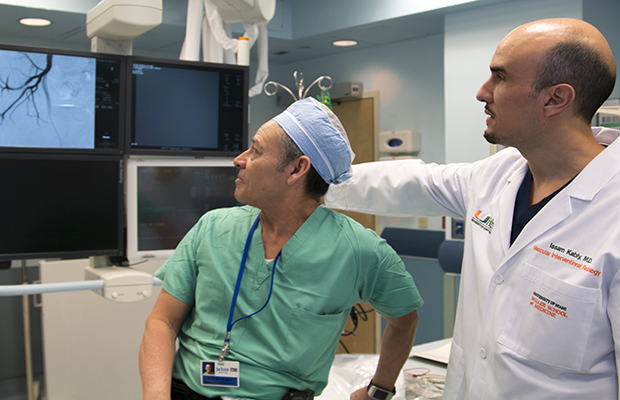
Javier Mondragon, 57, a certified anesthesia technologist at Jackson Memorial Hospital, has been in the operating room many times assisting patients as they undergo medical procedures – never thinking he’d one day be in their shoes.
But five years ago, Mondragon began to experience uncomfortable symptoms that kept him up at night. He had trouble urinating, suffered from a burning sensation, and felt like he always needed to use the bathroom.
“I had no idea what I had until I went to see my primary doctor and she did the prostate test,” said Mondragon. “She suspected that I had an enlarged prostate and did some lab work to determine if there were cancer levels.”
The diagnosis: Benign Prostatic Hyperplasia (BPH), also known as enlarged prostate – a condition in which the prostate gland grows larger than normal. BPH can raise prostate-specific antigen (PSA) levels that correlate with a higher risk of having cancer. Fortunately, Mondragon did not show signs of cancer. His physician prescribed medication to relieve the discomfort of prostate inflammation – but it would not treat his condition.
Over time, his symptoms worsened, landing him in the emergency department at Jackson Memorial Hospital.
“I couldn’t urinate at all, “said Mondragon. “They put a catheter in me to help empty my bladder for three days; it was a very painful process.”
Mondragon was desperate for a permanent treatment.
Seeing how much Mondragon was suffering, a co-worker recommended he see Issam Kably, MD, a UHealth – University of Miami Health System interventional radiologist at Jackson Memorial Hospital, who had begun doing a new procedure to treat the very condition that had caused him so much suffering.
Dr. Kably ordered an ultrasound and MRI on Mondragon. The results showed an enlarged prostate and a benign cyst. He was the perfect candidate to undergo the prostate artery embolization (PAE) procedure – a new, non-surgical alternative for men to improve urinary symptoms caused by an enlarged prostate.
At first, Mondragon was hesitant. He worried about the pain that would follow if he decided to move forward with the procedure.
“But Dr. Kably really took his time to make me feel comfortable,” Mondragon said. “I felt no pain or discomfort.”
The procedure took less than two hours, and Mondragon went home the same day with no scars.
Within a week, Mondragon experienced an 80 percent improvement with his symptoms.
Mondragon is grateful to Dr. Kably and the nursing staff at Jackson Memorial Hospital – where he has worked for 29 years – for helping him.
“This procedure made a big difference in my life,” said Mondragon. “I don’t have to get up in the middle of the night anymore, I don’t have to run to the bathroom, and I don’t have burning sensations anymore. I feel normal again.”