
Woman Undergoes Robotic Hysterectomy as a Safe Alternative
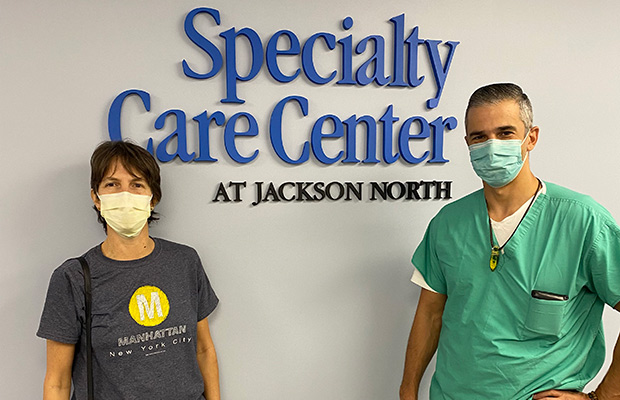
For years, Daniela de Majilat experienced irregularities and discomfort during her menstruation, but it wasn’t until last February that her symptoms intensified. She immediately reached out to her Jackson Medical Group gynecologist Adrian Roznowski, MD, FACOG, for help. Over the last three years, Dr. Roznowski has been treating de Majilat at Jackson North Medical Center for a large uterine fibroid.
After further examination, he determined that the fibroid was the culprit for de Majilat’s discomfort and constant bleeding. The diagnosis made Dr. Roznowski and de Majilat look into quick and effective solutions.
“We tried all traditional treatments including birth control pills, anti-inflammatory drugs, and a progestin-releasing intrauterine device (IUD) to relieve bleeding caused by the fibroid, but the bleeding had become unstoppable,” Dr. Roznowski said.
They also considered a uterine artery embolization (UAE), a procedure to shrink fibroids without undergoing surgery. During this type of procedure, the blood supply to the fibroids is cut off, typically causing them to shrink. Unfortunately, nothing was helping de Majilat’s pain and she was becoming anemic.
She and Dr. Roznowski discussed a more permanent solution to her problem and decided she should undergo a hysterectomy.
A traditional hysterectomy would carry additional risks for de Majilat, who was on blood thinners due to an existing circulatory issue. Luckily for her, Jackson North offers the robotic da Vinci procedure as an option.
The procedure lasts one to four hours with the surgeon making three small incisions in the patient’s abdomen for the surgical tools to access the area being operated on. The patient usually is scheduled to leave the hospital the same day as the surgery, followed by a two-to-four-week recovery period and a final follow-up appointment at six weeks.
“I spoke to Daniela about all her options, and she wanted the da Vinci procedure, especially when she learned how quickly she’d recover if all went well,” Dr. Roznowski said.
De Majilat’s cervix, uterus, and fallopian tubes were removed. Her ovaries remained, therefore eliminating the need for any hormonal therapy as a follow-up to the surgery.
“Removing fallopian tubes has become standard in the last eight years as they have been associated with causing ovarian cancer,” Dr. Roznowski said.
As for de Majilat, she highly recommends the surgery.
“This is a conversation between you and your gynecologist, as each case is different, but in my case, it’s been a very positive thing,” she said. “Working through this with Dr. Roznoswki and the nursing staff at Jackson North couldn’t have been better. The teams were friendly and professional. Their constant care and attention inspired me to want to become a nurse!”