
When a Stomach Issue Wouldn’t Go Away: A Patient’s Wake-Up Call About Diverticulitis


By Carla Palmer
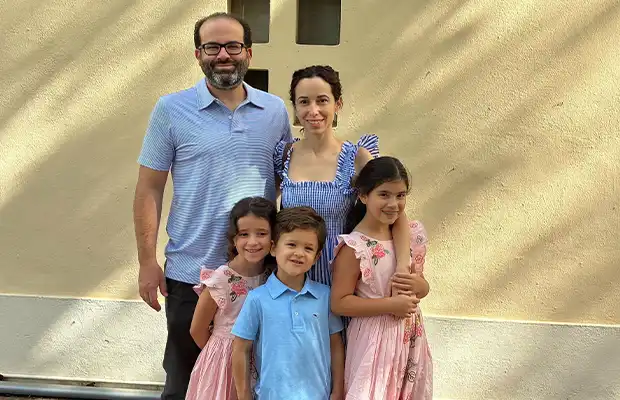
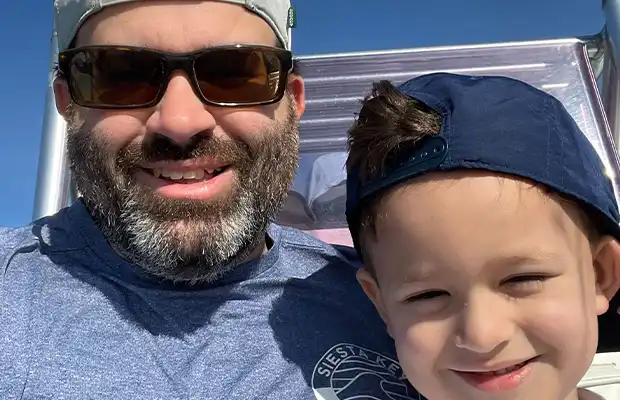
For years, 43-year-old Javier Gutierrez husband and father of three, assumed the pain would pass because it always did. Until one day, it didn’t.
His first episode happened during the height of the COVID-19 pandemic. He woke up with pain in the lower left side of his abdomen. It was uncomfortable but manageable, and within a few days, it went away on its own.
Unfortunately, the episodes came back. And they kept coming back. Eventually, Gutierrez realized something was wrong.
He was diagnosed with diverticulitis — a condition where small pouches form in the wall of the colon and become inflamed or infected. Antibiotics helped temporarily, but over time, the flare-ups became more frequent, more painful, and harder to bounce back from.
Diverticulitis isn’t rare, and that’s exactly why Eddie Gomez, MD, a general surgeon at Jackson Health System, believes stories like Gutierrez’s deserve attention.
“We talk about transplants. We talk about heart cases. We talk about gunshot wounds; they’re all important,” Dr. Gomez said. “But saving someone from diverticulitis who’s been suffering with poor quality of life is just as meaningful. For him, it changed his life.”
Most people who develop diverticulitis have an occasional episode that clears up with treatment. But when infections keep coming back, the inflammation builds and can create a dangerous cycle.
Gutierrez learned to recognize the warning signs: left-sided abdominal pain, fever, bloating, and loss of appetite. He would start antibiotics early and hope the episode would pass.
By December 2024, one flare-up became severe enough to land him in the hospital. Doctors found complications from the infection, and he needed IV antibiotics and close monitoring.
Gutierrez recovered, but in 2025, the episodes returned multiple times throughout the year.
His last flare-up right before Thanksgiving felt different.
“It didn’t feel like my other episodes,” Gutierrez said. “It was significantly stronger and really affecting my daily life.”
He went back to the emergency room and started new antibiotics. But instead of improving, his condition got worse.
Imaging showed the infection had progressed, and he was admitted again.
After being discharged on Thanksgiving Day, Gutierrez expected to get back to normal. But his body didn’t recover the way it usually did.
“I was miserable,” he said. “I was in a dark place.”
Dr. Gomez could see the toll it was taking.
“He couldn’t eat because he was afraid that if he did, it could set things off again,” Dr. Gomez said. “He was ending up in the hospital every few weeks.”
Ultimately, Gutierrez’s care team recommended removing the diseased portion of his colon to prevent future complications.
“I spent Christmas avoiding food entirely. I spent New Year’s lying in bed watching a UM game, not able to celebrate with my family. I was miserable,” Gutierrez said.
In January 2026, he underwent surgery with Dr. Gomez at Jackson West Medical Center.
Dr. Gomez performed a laparoscopic sigmoid colectomy — a minimally invasive procedure that removes the affected section of the colon and reconnects the healthy ends.
“It’s just a few small incisions, so the recovery is much faster,” Dr. Gomez explained.
In Gutierrez’s case, the surgery turned out to be more complex than expected due to chronic swelling and complications from the disease.
“The infected area had opened up and affected his surrounding tissue,” Dr. Gomez said.
After surgery, one moment stood out: Gutierrez felt his digestive system work normally again.
“The first time I could pass gas again, it was night and day,” he said. “After months of my body not working the way it should, that was everything.”
Within days, he was home and slowly getting back to normal — including something that had felt impossible just weeks earlier: eating without fear.
But the biggest change wasn’t just physical.
“A month and a half of not feeling normal turns you into a person you don’t want to be,” Gutierrez said. “Now when people ask how I’m doing, I tell them, ‘I’m alive.’”
Dr. Gomez said he sees this kind of transformation often, and it’s why everyday surgeries deserve more recognition.
“You go from being scared and down to being healthy again,” he said. “Nobody really appreciates that until they go through something like it themselves.”
According to Dr. Gomez, diverticulitis is most common in adults in their 50s, 60s, and 70s, but it can happen earlier. Genetics and chronic constipation can raise the risk.
“If your family has it, you may have a higher chance,” he said. “And when the colon has to work harder and produce more pressure, that can contribute to weak spots forming.”
Gutierrez’s story is a reminder that persistent symptoms shouldn’t be brushed off — even if they seem to come and go.
“I didn’t realize how sick I really was,” he said. “It changed my perspective.”
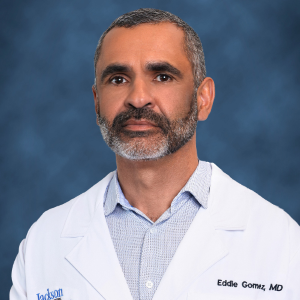
Eddie Gomez, MD
General Surgery
Jackson Medical Group
Jackson Medical Group – Jackson South
9380 SW 150th St. Suite 250, Miami, FL 33176
Jackson Medical Group – Jackson West
2801 N.W. 79th Ave. Suite 401, Doral, FL 33122